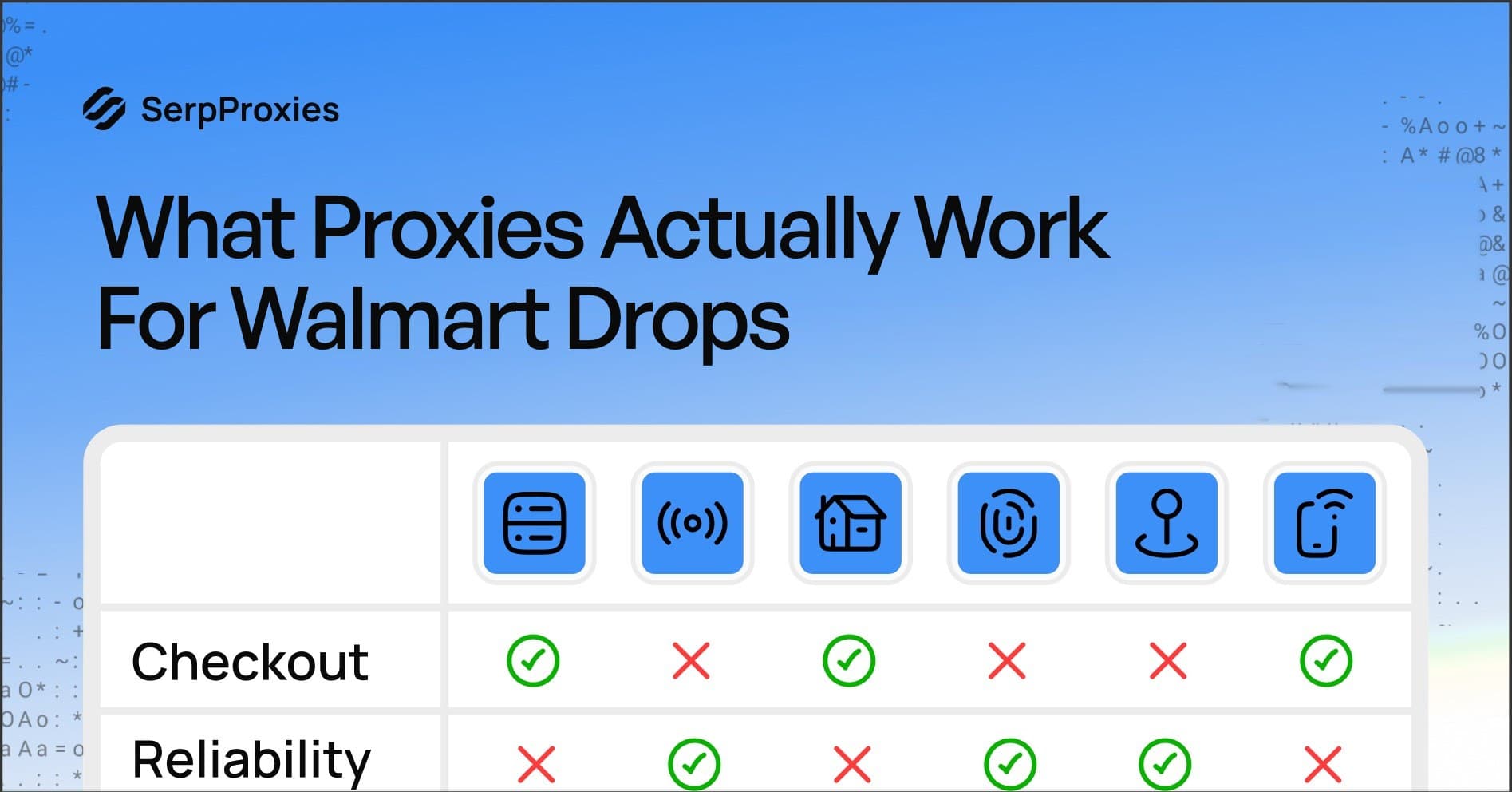
What proxies do you need for Pokémon TCG restocks? Residential proxies are the standard for Pokémon Center and Target. ISP proxies work well on Walmart and Best Buy where speed matters more. Datacenter proxies are blocked on Pokémon Center entirely and flag quickly on Target. The proxy type you need depends on the retailer's anti-bot stack, not just the product you are trying to buy.
Every major Pokémon TCG set release follows the same pattern. Pokémon Center crashes within seconds of going live. Target shelves are empty before the store opens. Walmart online restocks disappear in under a minute. Best Buy sells out during the checkout animation.
If you are trying to manually cop any of these, you are competing against setups built specifically to move faster than a human can. Getting the right proxies for each retailer is not optional — it is the difference between securing cards at retail and paying resale.
Here is what actually works at each retailer in 2026.
Pokémon Center
Pokémon Center is the most bot-resistant retailer in the TCG space. The official store upgraded its protection in early 2026 and now runs IP reputation checks at the point of cart creation. Datacenter proxies are blocked before your request even reaches the product. AWS, OVH, and Hetzner IP ranges are on the blocklist, full stop.
Residential proxies are the requirement here. Real home ISP IPs pass the reputation check that kills every datacenter attempt. For tasks running through Stellar AIO — the dominant bot for PKC drops — residential proxies with sticky sessions are the correct setup.
Set sticky sessions to at least 30 minutes. Pokémon Center runs on Shopify-based checkout, which expects a consistent IP from queue entry through payment. A rotating residential IP that changes mid-session resets your cart. Sticky sessions eliminate that failure point.
Run at least five captcha harvesters before the drop. PKC serves CAPTCHAs at the queue and at checkout. Clean residential IPs from private pools reduce captcha difficulty — burned IPs get harder challenges.
SerpProxies Premium Residential starts from $1.20/GB. For PKC specifically, private pool residential IPs are worth the premium because IP health directly affects captcha difficulty and cart success rates.
Pokémon Center setup: Residential proxies, sticky sessions 30 minutes minimum, one proxy per task, five-plus captcha harvesters.
Target
Target runs PerimeterX bot protection and DataDome on high-demand product pages. Both systems flag datacenter IP ranges immediately. For Pokémon TCG restocks, residential proxies are required.
Target's anti-bot is aggressive on queue entry but slightly less strict than Pokémon Center at the cart stage. That said, burned residential IPs from shared pools still fail on Target — the reputation check is real and it scores IPs before queue entry completes.
The timing window on Target restocks is extremely tight. Cards that hit the site during a restock sell out in 30 to 90 seconds on high-demand sets. Speed matters here alongside IP quality. This is one case where a private residential pool with lower latency routing to Target's CDN actually provides a measurable edge over cheaper shared residential proxies.
Target also runs purchase limits per account and per IP. One proxy per account is the hard requirement — multiple accounts sharing the same proxy will hit the purchase limit trigger and get both accounts flagged.
SerpProxies Private Residential at $2/GB gives you dedicated IPs not shared with other botters, which keeps reputation scores clean for Target's reputation-based queue entry scoring.
Target setup: Private residential proxies, rotating for monitoring, sticky for checkout, one proxy per account.
Walmart
Walmart uses PerimeterX with a different configuration than Target. The key difference is that Walmart's system is more tolerant of ISP proxies than Pokémon Center or Target. Datacenter IPs still get blocked on high-demand product pages, but ISP proxies — which look like residential IPs to PerimeterX — pass the reputation check without the same level of scrutiny.
For Pokémon TCG restocks on Walmart, ISP proxies are often the better choice over residential. The speed advantage of ISP proxies matters on Walmart because the restock window is extremely short and Walmart's checkout flow is faster than Pokémon Center's queue system. Getting through checkout in fewer seconds with a faster ISP proxy can make the difference on high-competition restocks.
SerpProxies Static ISP starts from $1.20 per IP with unlimited bandwidth. ISP proxies for Walmart do not burn bandwidth the way residential proxies do on longer drops, so the per-IP pricing model works cleanly here.
If ISP proxies are not available in the specific location you need, residential proxies work as a fallback. The anti-bot on Walmart is forgiving enough that fresh residential IPs from a reputable pool pass consistently.
Walmart setup: ISP proxies preferred, residential as fallback, one proxy per task.
Best Buy
Best Buy added stricter datacenter IP blocking to its queue system in late 2025. The protection level is below Pokémon Center but above basic Shopify boutiques. Datacenter proxies fail on high-demand product launches including Pokémon TCG sets.
Residential proxies are the safe choice for Best Buy. ISP proxies also work well here given the speed advantage and the fact that Best Buy's PerimeterX configuration is less strict about ISP ranges than Pokémon Center's Shopify-based system.
Best Buy restocks on Pokémon TCG are often tied to in-store availability, with online inventory varying. The online drop window is shorter than Target. Speed matters, which gives ISP proxies a slight advantage over slower rotating residential proxies if you have them configured correctly.
Best Buy setup: Residential or ISP proxies, sticky sessions, one proxy per task.
Monitoring Before the Drop
Restock monitoring is a different use case from checkout. For watching product pages for availability changes, you want rotating residential proxies hitting pages frequently without triggering rate limits. A rotating residential pool that cycles through IPs keeps your monitoring requests from accumulating hits on a single address.
Most serious TCG botters run monitoring through a separate proxy pool from their checkout proxies. This preserves checkout proxy reputation — you do not want your checkout IPs burning through requests during monitoring and arriving at the drop already rate-limited.
SerpProxies Premium Residential handles both use cases. Use rotating sessions for monitoring, switch to sticky for checkout.
Proxy Count and Setup by Retailer
The right proxy count depends on your task count and the retailer. The standard across all retailers is one proxy per task plus a 20 percent buffer for retries.
For Pokémon Center, where queue times can run 15 to 30 minutes, do not undercount your sticky session capacity. For Target and Walmart, where the restock window is 30 to 90 seconds, proxy count scales your chances directly — more tasks with clean proxies means more checkout attempts in the window.
Key Takeaways
Different retailers run different anti-bot stacks, and your proxy type needs to match. Pokémon Center requires residential proxies with sticky sessions — datacenter is fully blocked. Target requires private residential proxies with clean reputation scores. Walmart and Best Buy work well with ISP proxies for their speed advantage.
Across all four retailers, private proxy pools outperform shared pools because IP reputation at the start of the drop determines success at every subsequent stage. One proxy per task is non-negotiable. Monitor with rotating residential, execute with sticky residential or ISP depending on the site.
FAQ
What proxies do I need for Pokémon Center restocks?
Residential proxies with sticky sessions of at least 30 minutes. Datacenter proxies are blocked at cart creation. Private residential pools give you cleaner IP reputation scores, which reduces captcha difficulty during queue and checkout.
Can I use the same proxies for Target and Pokémon Center?
Yes, residential proxies work on both. Private residential is worth using for both sites since IP reputation affects performance on each. The configuration differs — set sticky sessions for Pokémon Center's longer queue, rotating for Target monitoring with sticky on checkout.
Do datacenter proxies work for any TCG restocks?
Not on Pokémon Center, Target, or Best Buy for high-demand sets. Walmart has slightly looser detection, but residential or ISP proxies are still recommended. For basic hobby shop sites without serious anti-bot protection, datacenter proxies may still function — but those sites are not where the most competitive restocks happen.
What is the best bot for Pokémon TCG restocks?
Stellar AIO is the dominant bot for Pokémon Center specifically. For Target and Walmart, bots with dedicated retail modules handle TCG restocks along with other product categories. The bot matters less than having clean proxies — the same bot on burned IPs underperforms a basic bot on clean private pool proxies.
How do I know when Pokémon TCG restocks happen?
Restock alert communities and cook groups monitor major retailers and post alerts in near real-time. Dedicated restock tracker tools watch product pages for inventory changes. Having alerts set up before you have proxies ready is wasted effort — the window is too short to react without being pre-configured.
Why do my tasks fail at checkout on Target?
Cart and checkout failures on Target are usually one of three things: burned IPs flagged by PerimeterX at queue entry, shared proxies hitting purchase limits across multiple tasks, or rotating sessions that change IP mid-checkout. Switch to private residential proxies, use one proxy per account, and configure sticky sessions for checkout.