What are Shopify proxies? Shopify proxies are IP addresses used to run bot tasks on Shopify-powered drop sites like Supreme, Kith, and independent sneaker boutiques. ISP proxies are the current standard for Shopify drops because they combine datacenter speed with residential trust scores and support the sticky sessions Shopify's checkout flow requires.
Most botters optimizing for Shopify drops focus on the wrong variables. They spend time tweaking bot settings and delays when the two factors that actually separate wins from losses are simpler: how close your proxy IP is to Shopify's servers, and whether your session stays locked to the same IP from queue entry through payment confirmation.
Get both right and your success rate improves. Get either one wrong and it does not matter how good your bot is.
How Shopify's Checkout Flow Punishes the Wrong Proxy Setup
Shopify's fraud detection does not just evaluate your IP at the moment of purchase. It tracks session consistency throughout the entire checkout flow. From the moment you enter the queue, through cart creation, to the payment page, Shopify expects to see the same IP address associated with the same session.
When the IP changes mid-checkout — because your proxy rotated or your sticky session expired — Shopify interprets it as session hijacking or bot behavior. The cart resets. In some cases, the account gets flagged. You go back to the start of the queue having burned the task and the proxy time.
This is why rotating residential proxies, which assign a new IP with each request, fail systematically on Shopify checkout flows even when the individual IPs are clean. The issue is not IP quality. It is the rotation behavior itself, which breaks the session consistency Shopify's system expects.
The Sticky Session Requirement
Sticky sessions lock your proxy to a single IP for a defined window. For Shopify drops, that window needs to be long enough to cover the entire checkout process, including queue wait time.
On a heavily trafficked drop — a Supreme release or a popular Kith collab — queue times can run 20 to 45 minutes. If your sticky session expires at minute 25, your cart resets with five minutes of queue time left. Set your sticky session minimum to 30 minutes. For drops with historically long queues, 60 minutes is safer.
ISP proxies are static by default, which makes this simpler. There is no sticky session window to configure — the same IP stays assigned for the life of your subscription. On Shopify drops specifically, this is a meaningful operational advantage over residential proxies that require explicit sticky session configuration.
Why Location Matters on Shopify Drops
Shopify stores are not all hosted on the same server. Shopify's infrastructure distributes across multiple CDN points of presence, and the specific origin server for a drop depends on the merchant's configuration. Most high-volume Shopify drop stores in the US route through Ashburn, Virginia, which is Shopify's primary US datacenter location.
The closer your proxy IP is to Ashburn, the lower your round-trip latency. A Virginia-based ISP proxy talking to a Shopify server in Ashburn adds single-digit milliseconds of network overhead. A California-based proxy on the same drop might add 60 to 80 milliseconds. That difference does not matter for casual browsing. It matters at drop speed where every millisecond of advantage compounds across multiple checkout steps.
On drops where queue entry happens faster than checkout processing can keep up — specifically releases where the queue drains in under two minutes — a 60-millisecond latency disadvantage is meaningful. The bots with lower latency complete more checkout steps in the same time window.
How to Match Proxy Location to Drop Server
Most ISP proxy providers, including SerpProxies, offer location targeting at the state or city level. For Shopify drops in the US, selecting an East Coast location, specifically Virginia or New York, gives you the best coverage for Shopify's US origin servers.
For EU-based Shopify drops — Palace, some Kith EU releases, EU-exclusive Supreme drops — choose ISP proxies located in Frankfurt or Amsterdam, which are Shopify's primary EU CDN locations.
Do not use West Coast proxies for East Coast-hosted drops unless the drop is specifically geo-restricted to that region. The latency cost is real and avoidable.
ISP Proxies vs Residential Proxies on Shopify
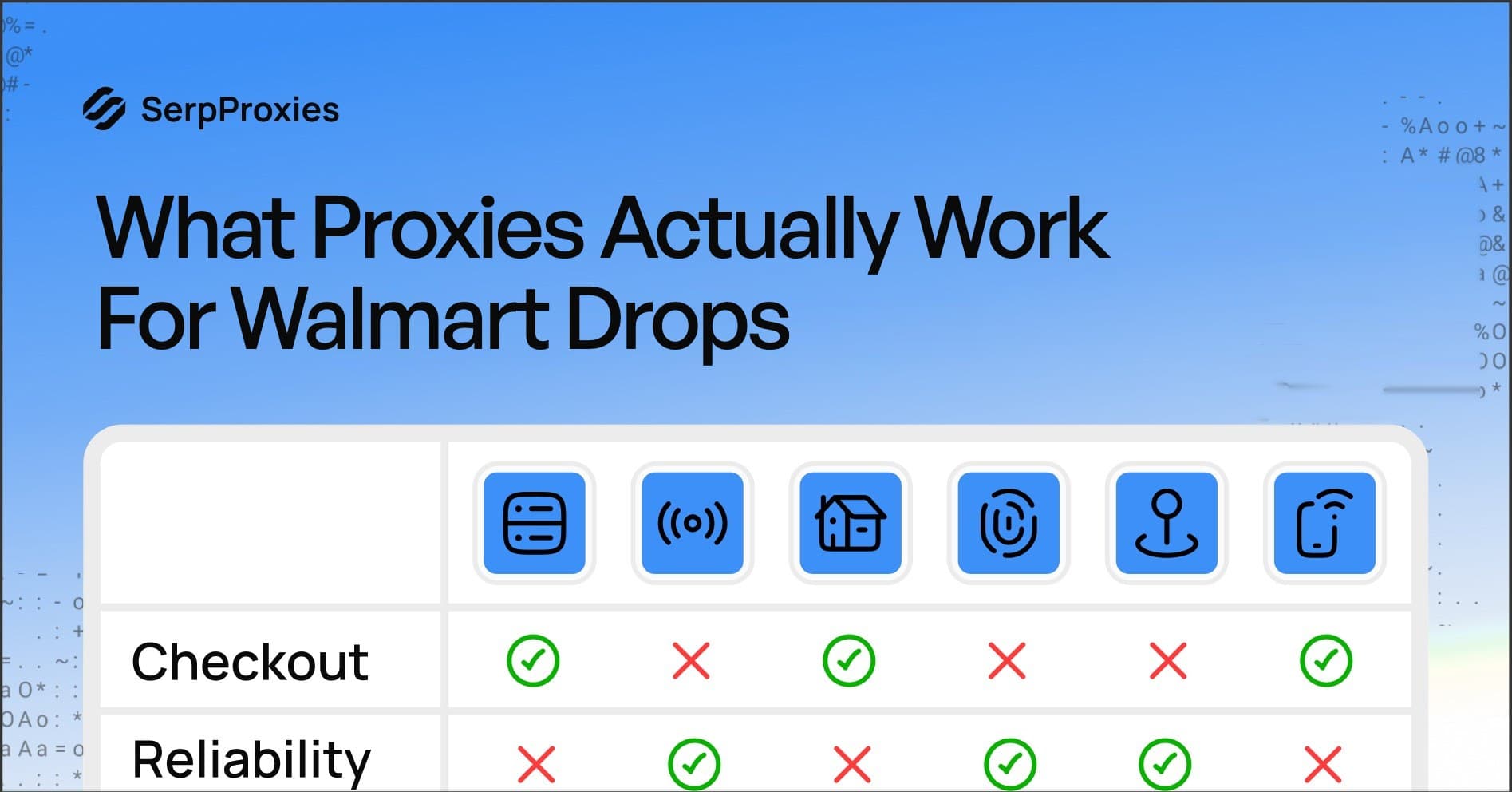
ISP proxies are the standard for Shopify drops, and the reason comes down to the combination of speed, session stability, and trust score.
Residential proxies route through actual home ISP connections. The latency is higher because traffic travels through a real user's home connection before reaching the target. On Shopify drops where checkout speed directly affects results, this latency overhead is a disadvantage.
ISP proxies are hosted in datacenters physically but registered under consumer ISPs like Comcast, Verizon, and AT&T. They deliver fiber-grade connection speeds while presenting a residential trust score to Shopify's fraud detection. Akamai and Cloudflare, which Shopify stores use, see a Comcast IP and treat it like a real user.
In community testing, 25 to 30 well-placed ISP proxies consistently outperform 100 residential proxies on the same Shopify drop. The speed advantage means ISP tasks move through the checkout flow faster, and the static IP means no session resets from rotation.
SerpProxies Static ISP starts from $1.20 per IP with unlimited bandwidth. Shopify drops with long queue times can burn significant bandwidth on extended sticky sessions — unlimited bandwidth means no per-GB cost anxiety while you are holding position in a 40-minute queue.
Cloudflare on Shopify Stores
Most serious Shopify boutiques run Cloudflare in front of their storefronts. Cloudflare adds an additional layer of bot detection on top of Shopify's native fraud system.
Cloudflare evaluates both the IP reputation and the behavioral fingerprint of each request. ISP proxies pass IP reputation checks because they do not originate from known datacenter ASN ranges. The trust score of a Comcast or Verizon IP is high enough that Cloudflare does not immediately challenge it.
Residential proxies also pass IP reputation checks and can have an advantage on Cloudflare's behavioral analysis because traffic routing through real home connections produces slightly more varied request timing patterns. For Supreme specifically, which runs aggressive Cloudflare protection, some botters prefer residential proxies over ISP.
The practical rule: ISP proxies for most Shopify boutiques, residential proxies for Supreme.
How Many Shopify Proxies You Need
The standard is one proxy per task. For 30 tasks on a Shopify drop, use at least 30 ISP proxies plus a 20 percent buffer — 36 proxies minimum — to cover retry attempts and session failures.
Do not share proxies across tasks. Shopify's session tracking ties checkout sessions to specific IPs. Multiple tasks running through the same proxy create overlapping sessions that Shopify's system detects as unusual activity.
For drops where you need geographic targeting, buy proxies in the target region rather than using location filtering on a remote pool. The latency benefit of a locally hosted proxy is larger than the latency of filtering requests through a proxy that remaps to a different location.
Key Takeaways
Shopify drops are decided by session consistency and proxy location. Sticky sessions are required — rotating proxies break Shopify's checkout flow and reset carts. Set sticky sessions to at least 30 minutes, 60 minutes for high-traffic drops with long queues.
ISP proxies are the standard because they combine datacenter speed with residential trust scores and are static by default. For US drops, East Coast proxy locations minimize latency to Shopify's Ashburn servers. One proxy per task with a 20 percent buffer. For Supreme and heavy Cloudflare sites, residential proxies are a strong alternative to ISP.
FAQ
What proxies work best for Shopify drops?
ISP proxies are the current standard for most Shopify boutique drops. They combine the speed of datacenter proxies with a residential trust score that passes Shopify's fraud detection and Cloudflare. For Supreme, which runs aggressive Cloudflare protection, residential proxies are a strong alternative.
Why do I need sticky sessions for Shopify?
Shopify's checkout flow tracks session consistency from queue entry through payment. If your IP changes mid-checkout because your proxy rotated, Shopify treats it as suspicious behavior and resets your cart. Sticky sessions keep your IP locked for the duration of the checkout process.
How long should my sticky session be for Shopify drops?
30 minutes minimum. For high-traffic drops with historically long queues, set 60 minutes. A sticky session that expires during a 40-minute queue wait resets your cart and wastes the entire queue time.
Does proxy location matter for Shopify drops?
Yes. Most US Shopify drops route through Ashburn, Virginia. East Coast ISP proxies have 60 to 80 milliseconds less latency than West Coast proxies on those drops. At drop speed, where checkout steps need to complete in a compressed window, lower latency adds up across multiple steps.
How many proxies do I need for a Shopify drop?
One proxy per task plus a 20 percent buffer. For 30 tasks, have at least 36 proxies available. Do not share proxies across tasks — Shopify's session tracking detects overlapping sessions from the same IP as suspicious activity.
Can I use datacenter proxies for Shopify?
On basic Shopify boutiques without Cloudflare or serious anti-bot protection, datacenter proxies may function. On any store running Cloudflare, Akamai, or PerimeterX, datacenter ASN ranges are blocked on contact. ISP proxies give you datacenter speeds without the datacenter ASN flag.